Takahashi Shōtei (1871–1945), who also signed his work Hiroaki, was a central figure in the shin-hanga movement that renewed Japanese woodblock printing in the early twentieth century. Here he turns to Inatori Bay on the Izu Peninsula, where traditional sailing junks ride the water against a low, graduated sky. The scene belongs to a body of atmospheric coastal landscapes that record a working maritime Japan as it was beginning to change.
The print relies on bokashi, a hand-applied gradation of pigment across the block that lets one tone dissolve into the next. Sky and water are built from these soft transitions rather than hard outlines, so the light seems to settle over the bay. The junks read as quiet silhouettes, their angled masts and broad hulls anchoring the composition.
On a wall the image keeps a steady, low-key presence. Its muted blues and greys sit well in a calm room — a bedroom, a study, a hallway where the eye can rest. The horizontal format suits a . . . Read More >>
Takahashi Shōtei (1871–1945), who also signed his work Hiroaki, was a central figure in the shin-hanga movement that renewed Japanese woodblock printing in the early twentieth century. Here he turns to Inatori Bay on the Izu Peninsula, where traditional sailing junks ride the water against a low, graduated sky. The scene belongs to a body of atmospheric coastal landscapes that record a working maritime Japan as it was beginning to change.
The print relies on bokashi, a hand-applied gradation of pigment across the block that lets one tone dissolve into the next. Sky and water are built from these soft transitions rather than hard outlines, so the light seems to settle over the bay. The junks read as quiet silhouettes, their angled masts and broad hulls anchoring the composition.
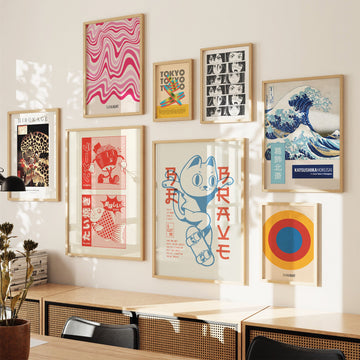
On a wall the image keeps a steady, low-key presence. Its muted blues and greys sit well in a calm room — a bedroom, a study, a hallway where the eye can rest. The horizontal format suits a space above a bed, a bench, or a long shelf, and the restrained palette holds its own without competing with the furniture around it.
This is a gallery-style edition. On fine-art paper and framed prints, a wide printed border surrounds the image in the manner of a museum mat, holding the same proportion whether the sheet is small or large. The canvas edition is stretched over a solid wooden frame instead, and hangs without a border or additional framing. Each version is produced in Europe to order.
Frequently asked questions
What does the scene show?
Traditional wooden sailing junks at rest in Inatori Bay, on the Izu Peninsula, beneath a softly graded coastal sky.
What is bokashi, the technique used here?
Bokashi is a hand-applied gradation of pigment across the printing block, letting one colour fade gradually into another. It gives the sky and water their atmospheric glow.
What is shin-hanga?
Shin-hanga, meaning “new prints,” was an early twentieth-century movement that revived traditional woodblock methods with a fresh attention to light, weather, and mood.
Why are junks a common subject in these prints?
Junks were the everyday vessels of Japanese fishing and trade. Their distinctive silhouettes made them a natural emblem of coastal life in landscape prints.
<< Read Less
Japan historical period: Showa 昭和 (1926-1989)
Place of origin:
Izu,
Chubu region
Check out other artwork of Takahashi Shōtei
#Bay
•
#Boat
•
#Coastal Landscape
•
#Harbor
•
#Hiroaki Takahashi
•
#Japanese Art
•
#Japanese Woodblock Print
•
#Junks
•
#Maritime
•
#Moon
•
#Nautical Scene
•
#Night
•
#Sea
•
#Shin-Hanga
•
#Ships
•
#Takahashi Hiroaki
•
#Takahashi Shōtei
•
#Traditional Ships
•
#Twilight